





Artificial Intelligence (AI) is everywhere.
In Vietnam, people use AI tools daily for writing, translation, marketing, customer support, and even education. AI awareness is high, adoption at the individual level is growing fast, and conversations about AI happen across industries.
Yet, when we look at manufacturing, the picture is very different.
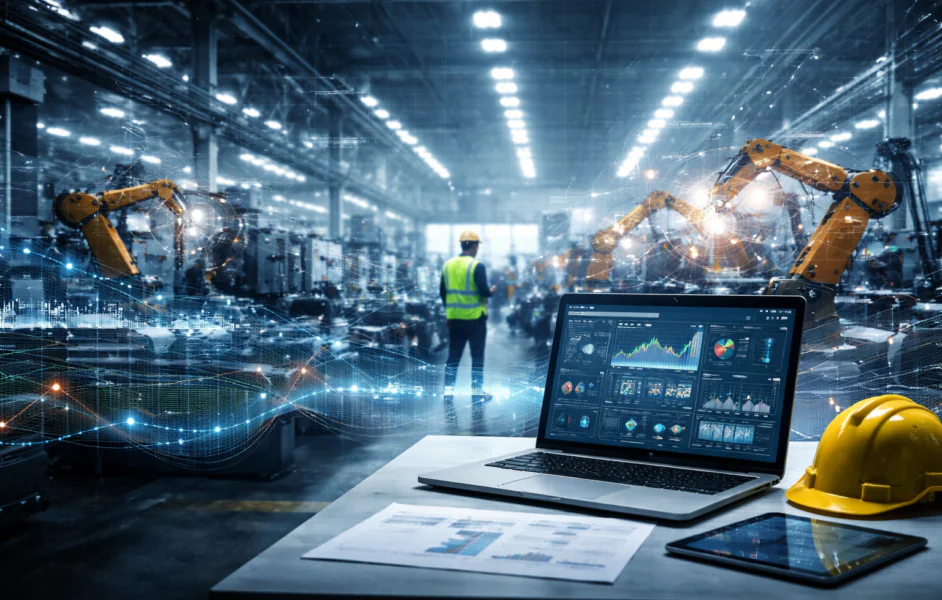
Despite strong interest and long-term potential, AI has not yet deeply penetrated Vietnam’s production and industrial systems. The question is no longer “What is AI?” but rather “Why hasn’t AI changed how factories actually work?”
This article explores the real reasons behind that gap — and what must happen next.
Vietnam is often seen as a promising AI market:
However, most AI usage today stays in non-core activities, such as:
These are useful — but they do not redefine productivity at the factory level.
In manufacturing, where efficiency, precision, and scale matter most, AI adoption remains limited.
AI does not operate in a vacuum.
To work effectively in production, AI requires three foundational layers:
Many manufacturing companies in Vietnam are still struggling with step one.
A large number of factories are still dealing with:
Without standardized digital processes, AI has nothing reliable to learn from.
In this situation, applying AI is like installing an autopilot in a car without sensors.
Manufacturing generates huge amounts of data:
The problem is not data quantity — it’s data quality.
Common challenges include:
AI systems require clean, continuous, and contextual data.
Without it, AI outputs become unreliable or unusable.
Unlike basic automation or software deployment, AI in production does not deliver instant ROI.
Successful AI applications in manufacturing often take:
This creates hesitation among companies that:
As a result, AI projects are often postponed, downsized, or limited to pilot phases.
When done correctly, AI can fundamentally change production performance.
High-impact use cases include:
These applications directly affect:
But reaching this stage requires a systemic approach, not isolated AI tools.
To move from experimentation to transformation, three shifts are critical:
Companies must finish foundational digitalization:
AI should be the next layer, not the first one.
Relying entirely on vendors is risky.
Manufacturers need:
AI is not just a tool — it is an organizational capability.
AI adoption in manufacturing is a marathon, not a sprint.
Companies that succeed:
Those who wait for “perfect conditions” often fall behind.
Vietnam stands at an important crossroads.
AI is already reshaping global manufacturing. Countries that integrate AI deeply into production will:
The real challenge is not whether Vietnam can adopt AI in manufacturing —
but whether it can do so fast enough and deeply enough.
AI has entered Vietnam’s daily life — but it has not yet entered the factory floor in a meaningful way.
Bridging this gap will define the next decade of industrial competitiveness.
For manufacturers, the question is no longer:
“Should we use AI?”
But:
“Are we building the foundations that allow AI to truly work?”